
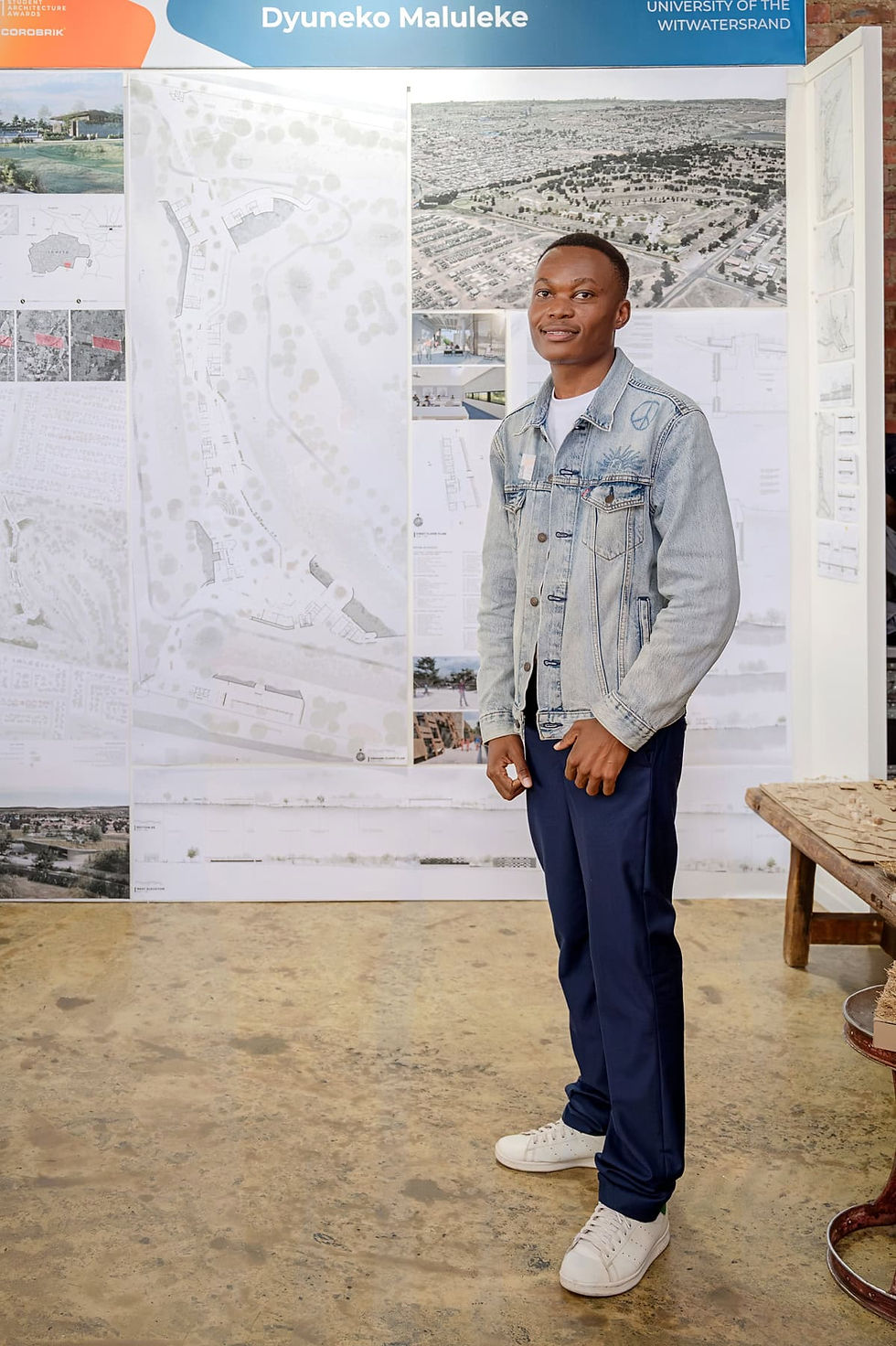

Dyuneko Maluleke
University of the Witwatersrand
why did you choose to study architecture?
I have always been curious, even as a child, often asking many questions with few answers. As I grew older, I began to see the world as consisting of two types of people: creators and consumers. I found greater fulfilment in the idea of creating. This is when architecture resonated with me, not only through the planning and design of structures, but also through its psychological role. Observing how people interact with spaces, and develop a sense of ownership and belonging, gives me fulfilment that I could not find in any other field besides architecture and design.


PROJECT
Fostering the economic porosity of Soweto Country Club through public spaces
PROJECT SUMMARY
This research investigates the potential transformation of the Soweto Country Club into a multifunctional and porous landscape that promotes both spatial justice and socio-economic growth. It proposes an architectural intervention that reclaims the underutilised roughs of the golf course, marginal, non-playing zones, as catalytic spaces for skills development, entrepreneurship, and social integration. Rather than a static architectural addition, the intervention is envisioned as a spatial journey: a connective pathway embedded with purposeful programmes. Its broader aim is to bridge, both physically and symbolically, the historic divide between Pimville and Eldorado Park, two neighbouring communities shaped and segregated by apartheid spatial planning. Founded in 1974 by black golfers from Soweto, the Country Club has deep historical significance as one of the first golf courses to welcome black South Africans. Today, however, it remains a mono-programmed facility, enclosed by 3.11km of concrete palisades and steel fencing.
Designed under the logic of security and exclusivity, these barriers have created stark visual and spatial disconnection, reducing the golf course to an isolated enclave. Over time, the perimeter has become a neglected edge: hosting informal billboards, graffiti, and urban waste. This stands in sharp contrast to the cultural vibrancy of Soweto itself, alive with street vendors, artisans, designers, storytellers, performers, and food innovators. The research, therefore, examines how the Country Club can transition from its exclusionary, single-purpose use to a shared civic asset that embraces, rather than alienates, its communities. It examines how targeted interventions along the roughs could host public and semi-public programmes that enable cultural exchange, small business incubation, and golf-related skills training. Particular emphasis is placed on supporting emerging entrepreneurs and local golfers, especially those in Pimville and neighbouring areas, who currently face limited access to markets and suitable spaces to operate.